
Dating in your 40s is genuinely harder than it was in your 20s — the pool is smaller, the algorithm is working against you, and the scene has changed in ways that optimism alone can’t fix. The people who navigate it well do so by lowering the stakes of each individual interaction and raising their standards for what they’ll tolerate long-term.
That’s the honest version. If you’ve been out there for a while and something feels off — not with you, but with the whole situation — you’re reading the environment correctly. This is what’s actually happening, and what actually helps.
For context on the broader picture of dating after 40, there’s more ground to cover than any one article can hold. But let’s start with the mechanics.
TL;DR
- The dating pool is structurally smaller at this age — not because of anything you’re doing wrong, but because of demographics and how apps algorithmically deprioritize older profiles.
- Lower the stakes on each individual interaction while holding firm standards for long-term behavior.
- Friend setups and consistent social presence consistently outperform heavy app use at this stage of life.
The dating pool really is smaller — and pretending otherwise doesn’t help
The supply problem is real. The single population shrinks with age — and it shrinks asymmetrically, with fewer single men available relative to single women as both age past 40. That’s not a mindset issue. It’s a structural one.
The apps compound it. Match rates drop notably after 35 — not because of anything you did, but because of how apps rank and surface profiles by age. The algorithm deprioritizes older users. Knowing this doesn’t fix it, but it does stop you from internalizing it as a personal failure.
What this looks like in practice: at 44, the visible pool on a given app skews heavily toward people who are either actively avoiding commitment or recently out of a long marriage and not yet ready for something real. So the usable pool is smaller still than the raw numbers suggest. That’s a structural constraint. You respond to it by adjusting your relationship with the channel — not by working harder at the wrong tool.
Dating in your 40s: how to use apps without burning out

Think of it this way: you don’t press the accelerator as far down as you can and zip around trying not to wreck. That’s how most people in their 40s should be using dating apps — carefully, with a purpose, not at full throttle.
Practical dating tips in your 40s that actually work:
- Limit daily swipes. Arbitrary volume doesn’t improve outcomes; it accelerates burnout. Pick a small number and stick to it.
- Read profiles before swiping. At 28, you could afford to sort it out later. At 42, your time is not free. Read what they wrote.
- Know the ENM scene. A significant percentage of profiles at this age are ethically non-monogamous — open marriages, polyamorous arrangements, or vaguely worded “open to connections.” None of that is wrong, but the issue isn’t just volume. It’s that people in these arrangements often feel no obligation to lead with it, which means you can invest weeks in a conversation before understanding the actual situation. The frame that helps: when you see it, it’s information about compatibility, not a referendum on your options. Process it accordingly and move on without bitterness.
- Move off-app faster. If a conversation is going somewhere, suggest meeting within a week. The app is a door, not a relationship.
If you’re already past the point of diminishing returns, our guide to dating app burnout names what you’re experiencing and gives it a framework.
For anyone wanting specific platform recommendations, the best dating apps for women piece breaks down which ones actually work at this age and why.
Social networks and friend setups still outperform the algorithm
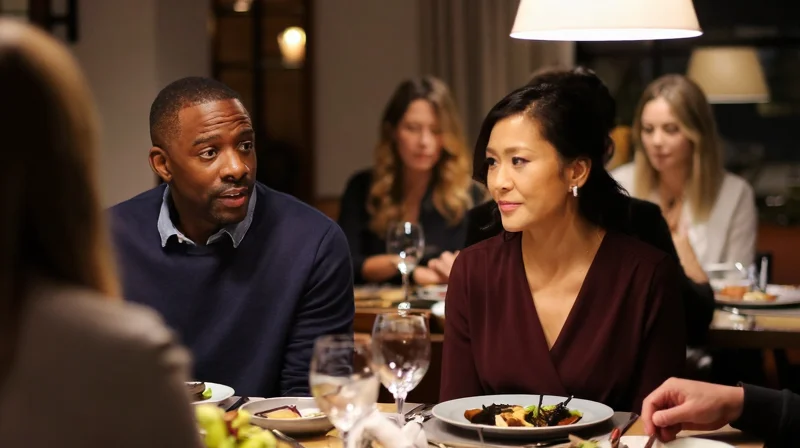
The most practical reframe on this: don’t look at it as dating — look at it as socializing. The rest follows.
That reframe is doing a lot of work. When you approach every interaction as a potential audition, you perform. When you approach it as social contact with no predetermined outcome, you’re actually yourself. And at this age, the version of you that shows up naturally is far more compelling than the version of you trying to close a deal.
Friend setups remain the gold standard — not because they’re more romantic, but because a partially vetted introduction removes an enormous amount of uncertainty from the early stages. Someone who knows both of you has already done implicit compatibility filtering. That’s not nothing.
Expanding your social surface isn’t about forcing yourself to attend events you hate. It’s about building a life where new people can enter it organically. Here’s the mechanism competitors never explain: a recurring fitness class, climbing gym, or local volunteer gig where you show up consistently gives you multiple low-pressure contact points before any romantic context is introduced.
You’re not just exposing yourself to people — you’re letting people assess you across time. That’s exactly what the 3-3-3 rule tries to replicate artificially with dates. Consistency in a shared context does it naturally, without the performance pressure.
What actually attracts people at this age — it’s not what the coaches say
Dating in your 40s as a woman, the clearest signal cuts through all the noise: there’s nothing more attractive than a man who is emotionally intelligent and able to communicate well and with compassion.
Not confidence. Not abundance mentality. Not some repackaged alpha framework. Emotional availability and clear communication — that’s what actually moves the needle.
For men in their 40s, the mirror image applies. Strip away the sales pitches and what men at this age genuinely want is someone with her own life. Her own friends, interests, income, and opinions. Someone who wants them rather than needs them to fill a void.
In early dating, that shows up as someone who doesn’t reschedule her whole week around a first date, who has opinions about where to go, and who isn’t measuring the relationship’s potential after every text.
The dating coach industry has a financial incentive to tell you the answer is a mindset shift or a technique. The real dating advice in your 40s is simpler: show up as someone who has done the work on themselves, who can sit in discomfort without shutting down, and who communicates what they want without needing three days of subtext decoding to get there.
Stop asking “do they like me?” Start asking “do I like them?” That’s the whole shift.
The standards that actually matter: when to stay and when to leave
You’ve already spent years in the wrong relationship. You have zero tolerance for spending months in the wrong situationship. That’s not bitterness — that’s information. Use it.
The most actionable standard I’ve found for this stage of life: fuck yes or fuck no. Not “I’m not sure, but I’ll give it more time.” Not “they have potential.” Not “I’m being too picky.”
If you can’t find genuine enthusiasm for this person after a reasonable number of interactions, the answer is no. Protect your time.
That doesn’t mean expecting fireworks on date one. It means that somewhere in the early weeks, you should feel something real — not just relief that someone decent showed up.
Judge actions, not promises. If you’re decoding their texts with three friends, nothing is happening. What someone does is the data. What they say is noise until it matches.
Three months is nowhere near enough time to know someone — and anyone who rushes you has their own reasons for rushing you.
The grief-to-readiness timeline deserves its own paragraph because people consistently confuse the two. Being over a relationship means you stopped crying, stopped checking their social media, stopped replaying the ending. Being ready for a new one means you have enough of yourself back to give something to someone else. Those are different timelines — sometimes by months, sometimes longer.
Conflating them is how you end up in a rebound that damages both people. If you’re dating again after divorce, take the question seriously before you answer it.
Blended family logistics are a real variable and they deserve more than a passing mention. If either of you has young kids, the question of how quickly the relationship should progress is driven less by feelings and more by custody schedules and co-parenting dynamics. Anyone who wants to accelerate past what those allow is either not thinking clearly about what they’re asking, or has their own reasons for rushing — neither of which is your problem to accommodate. Dating someone with kids walks through what’s actually involved when things start to get serious.
Set strong standards for behavior. Not superficial checklists. Behavior.
How do you know when it’s actually serious
This is the question most people avoid asking directly, and almost no one answers honestly. The clearest signal isn’t a conversation or a label — it’s being integrated into their actual life. Not their dating life. Their life.
Do you know their friends? Have you met them? Are you in their calendar the same way their other commitments are?
The other signal: consistency over time. Intensity in the first month is cheap. Anyone can sustain effort when the relationship is still novel and nothing’s been tested. The data point that matters is how they show up after the first conflict, after a hard week, after the initial excitement has settled into something quieter.
That’s the version of the person you’re actually agreeing to.
A useful threshold: if you’ve been seeing each other for three months and you still can’t tell whether it’s serious, it probably isn’t. That’s not cynicism — it’s pattern recognition. Clarity by that point isn’t too much to ask.
Frequently asked questions
How difficult is dating in your 40s?
Dating in your 40s is structurally harder than at younger ages — the single population shrinks, apps deprioritize older profiles algorithmically, schedules are fuller, and many potential partners carry co-parenting logistics or post-divorce complications. These are external constraints, not mindset problems. Acknowledging that makes it easier to respond practically rather than blame yourself for outcomes that aren’t within your control.
What is the 7-7-7 rule for dating?
The 7-7-7 rule suggests spending roughly 7 hours together in different contexts, across 7 different interactions, over approximately 7 weeks before making significant relationship decisions. Worth knowing, but the specific numbers are less important than the underlying logic: time across varied contexts is better data than intensity in a few. Early chemistry is not the same as actual compatibility, and this framework is one way of slowing down long enough to find out the difference.
What is the 3-3-3 rule for dates?
The 3-3-3 rule suggests evaluating someone across 3 dates, 3 weeks, and 3 different settings before deciding whether to pursue things seriously. Different contexts reveal different aspects of a person — you need to see someone in at least one low-stakes, one slightly pressured, and one genuinely casual situation before you have a reliable read. The framework works not because the numbers are magic, but because it forces you to resist deciding too early based on too little.
What do guys in their 40s want?
Men in their 40s consistently report wanting emotional availability, clear communication, and a partner who has a full life of their own — not someone who needs a relationship to feel complete. They’re also navigating real complexity: co-parenting schedules, career transitions, post-divorce identity rebuilding. What they’re generally not looking for is someone who mistakes intensity for connection, or who interprets their caution as lack of interest.
The people who navigate dating in their 40s well don’t do it through optimism or technique. They hold their expectations for individual interactions loosely — any given date is a low-stakes social event, not an audition — and they hold their standards for long-term behavior tightly. That combination is harder than it sounds and more effective than anything else on offer. Start there.