
Dating over 50 is not the confident fresh start most advice sites describe — it’s often the most psychologically complex dating experience of your adult life. About half of adults 50 and older have used a dating site in the past three years, which means millions of real people are quietly navigating something the advice industry insists should feel empowering.
What’s promised isn’t harmless — it keeps people on platforms that are wrong for their emotional state and looking for the confidence they were told they should already have. Every piece of advice in this space leads with the same reframing — “you know what you want now,” “this is your time” — recommends the same five apps, glosses over scammer density, and lumps widows and divorcees into a single category called “mature singles.” What actually determines whether a dating app is worth your time, what the emotional reality looks like for most people, and what to do with it — that’s what this covers.
TL;DR
- Niche apps marketed to your demographic often have higher scammer density than mainstream ones — age-targeted platforms are a more predictable target, not a safer space.
- The single most important variable in choosing a dating app is how many active users are within the distance you’re actually willing to travel — not the brand, not the features, not the editorial ranking.
- Feeling invisible is not a mindset problem — it’s the dominant emotional experience of over-50 dating, and it’s a legitimate obstacle, not a personal failure.
The “Confidence Era” Framing Is Wrong for Most People
The standard framing in this space opens with the same optimism-forward line — “a love mulligan,” “the best is still to come,” “life’s next chapter.” All of it is describing someone else’s experience.
The dominant sentiment in over-50 dating communities isn’t excitement — it’s exhaustion. People describe giving up, feeling invisible, and not having the energy to convince someone they’re worth dating. Some never even download a single app.
The dominant emotional experience of over-50 dating is closer to grief management than lifestyle optimization. That’s not a mindset problem. It’s a documented pattern among people rebuilding identity after long marriages, coming out of decades-long partnerships, or re-entering a social scene that has completely changed. Pretending otherwise is what keeps people on the wrong platforms — and in the wrong headspace — for far too long.
Knowing what you want is a genuine advantage, if you actually know what you want. A lot of people in this situation are still figuring that out, and that’s not a failure — it’s honest. The advice industry’s confidence framing mostly works for people who were already confident. For everyone else, it’s the tutorial for a game you weren’t playing.
How to Pick a Dating App When You’re Over 50 (Local Density Matters More Than Brand)
Here’s what most dating advice won’t tell you: the app with the best marketing is often the worst app for your specific location. National brand recognition and active users in your metro area are completely different things. An app with 10 million registered users but 80 active profiles within 40 miles of where you live is not useful to you.
The honest framework for app selection involves one step that happens before you read any review: use the free tier, check how many profiles appear within a realistic distance, and look at last-active dates. If you’re seeing profiles from people who were last active six months ago, you’re not on a dating app — you’re on a digital ghost town.
Real user experience in your market is more reliable than any app ranking. Bumble consistently outperforms niche apps in most markets because it has more real, local, recently active users — not because of features or star ratings. That’s the variable, dating for over 40 or navigating dating for over 50s in a smaller city. Not whether a platform was designed “for your demographic.”
For a closer look at how specific apps perform across different regions and age brackets, our best dating apps for over 50 guide covers what we’ve actually tested — not just feature comparisons.
Before committing to any paid subscription, run through this checklist:
- Set your distance filter to something realistic (25-40 miles, or whatever matches your actual life).
- Count the profiles that appear on the free tier before you pay anything.
- Check the “last active” indicators where available — stale profiles are the main form of false advertising in this space.
- Swipe for a week before judging. One week of free-tier data is more honest than any review site.
- If you’re in a smaller city or rural area, the mainstream apps often outperform the niche ones simply because of volume.
“Trying several apps” isn’t advice. It’s a way of not answering the question. The answer is: start with whichever app has the most real, active users within the distance you’re actually willing to travel.
The Scammer Problem Is Worse Than Anyone Will Tell You
Some platforms are promoted heavily as scam-resistant, with camera verification marketed as the key differentiator. What users actually report is different: sites described as “crawling with scammers and creeps” and fake accounts requesting contact information within days of joining.
Both claims cannot be accurate at the same time. The gap between what’s marketed and what users actually experience is itself the story — and you deserve to know it exists before you pay $34.99 a month.
The red flags on these platforms are consistent enough to memorize:
- Contact that quickly moves toward email or phone number, before any real conversation has happened.
- Matches from outside your search area with no explanation of why they’re there.
- Profiles that read as polished and articulate but then produce messages that can’t spell or don’t match the claimed background.
- Early mentions of cryptocurrency, real estate investment, or “a business opportunity” — this specific pattern targets the 50+ demographic disproportionately.
- Anyone who can’t or won’t meet in person within a reasonable timeframe.
If you’ve already encountered this pattern, our guide on online dating scams goes deeper on the specific tactics being used and how to document and report them.
Scammer density rarely appears as a weighted factor in app recommendations. Camera verification is presented as though it solves the problem. User reviews suggest it doesn’t. The practical implication: treat age-targeted platforms with higher skepticism than mainstream apps, not lower — they’re a more predictable target.
Widows and Divorcees Are Not in the Same Position — Stop Treating Them That Way

The standard advice treats “people re-entering the dating scene after 50” as a single category. It isn’t. A widow re-entering dating and a divorcee re-entering dating have almost nothing in common psychologically, and advice that doesn’t account for this is useless to both.
A widow is often grieving while dating. That affects how quickly she can emotionally invest, what kind of intimacy she’s ready for, and how she responds when a new partner invites comparison — even implicitly — with someone who died. The timeline for emotional availability isn’t linear, and it doesn’t map onto the standard “take it slow” advice in any useful way. “Taking it slow” might mean something completely different each week.
A divorcee, by contrast, is more likely navigating co-parenting logistics, financial restructuring, and the social fallout of a marriage ending in a community that knew both people. She may be processing anger, relief, guilt, or all three simultaneously. Her re-entry into dating is complicated not by grief but by the ongoing practical reality of a life that had to be restructured around someone else’s absence.
Before entering either process, one exercise cuts through the noise: write down five things you genuinely must have in a partner — not preferences, requirements — and five absolute deal-breakers. Do it before you look at a single profile. The answers are different for someone grieving than for someone processing the end of a bad marriage, and the difference is information you need before you start swiping.
For widows specifically, the emotional realism of re-entering dating after a long marriage is its own terrain. For divorcees, the specific dynamics of dating again after divorce — particularly when adult children, finances, or co-parenting are involved — deserve their own framework. These are not the same article.
Neither person is simply “a mature single who’s been out of the dating scene.” Both deserve advice that starts with where they actually are — and conflating the two produces guidance that lands nowhere for either.
Practical Moves That Actually Work: Banter, Bounds, and Recognizing Diminishing Returns
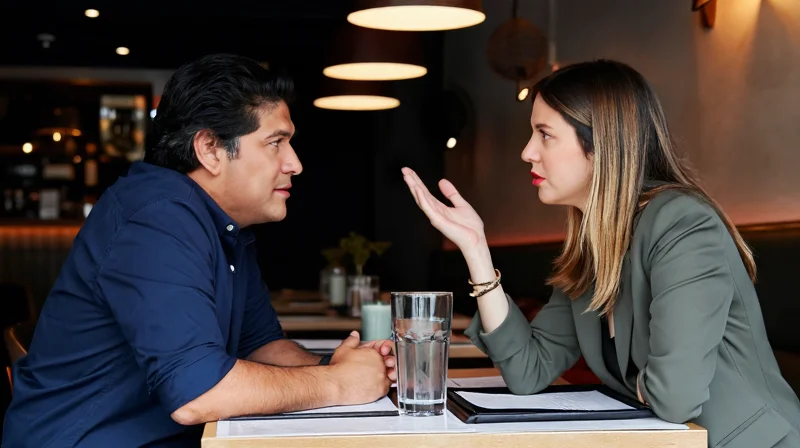
The best single piece of tactical advice in the entire over-50 dating space comes from stand-up comedy. It’s called the “tight five” — prepare roughly ten minutes of reliable material before a first date. Stories that land, questions that open things up, a few observations you know are true. Not a script, but a warm-up so your actual personality can take over.
First-date nerves at 55 are not a confidence problem — they’re what happens when someone who spent twenty-three years not having to do this suddenly has to do it again.
On the financial conversation: be honest with yourself early about what you can spend on dating, what financial disparities you’re comfortable with, and when to raise it. The 50+ demographic is navigating retirement savings disparities, alimony, adult children, and real estate in ways that the “who pays for dinner” framing completely misses. The practical version looks like this: “I want to be honest that I’m working through some financial restructuring right now, so I’m not in a position to do expensive dinners regularly” — said once, early, matter-of-factly — is more attractive than six weeks of awkward bill-splitting followed by a conversation neither of you wanted to have.
On sex: have the talk before you’re in bed. Monogamy expectations, physical limitations or changes, safe sex — framing it as “things we both need to know” works because it’s accurate. You’re not killing the mood. You’re treating the other person like an adult.
On when to quit an app: nobody gives this advice, and it’s the most useful thing I can tell you. Signs you’re experiencing diminishing returns:
- Your last-active swipe was more than a week ago.
- You’re declining matches without looking at the profiles.
- You haven’t felt genuine interest in a match in over a month.
- You’re opening the app out of habit, not hope.
That last one is important. If you recognize it, you’re probably already experiencing dating app burnout — which is a real and documented pattern, not a personal failure. Leaving an app that isn’t working is not quitting. It’s resource allocation.
Frequently asked questions
What is the best dating site for over 50?
There’s no universal answer — the right app for dating for over 50 depends almost entirely on how many active users are within a realistic distance of where you actually live. You can only assess this by using the free tier before paying anything. Editorial rankings treat national user counts and feature lists as the deciding variables; they aren’t.
What is a red flag when dating in your 50s?
Beyond standard red flags, the most specific pattern for this demographic is someone who contacts you on a dating app and quickly moves toward requests for your phone or email, mentions cryptocurrency or investment opportunities, or seems to have arrived from outside your search area without explanation. These patterns are consistent across user reports on age-targeted platforms and are worth recognizing before they escalate.
What is the 3-3-3 rule for dating?
The 3-3-3 rule suggests waiting three days before texting, meeting after three exchanges, and dating three months before defining the relationship. The first part is largely irrelevant over 50 — the actual problem is too many endless text chains, not not enough waiting. The more useful inversion: move to an in-person meeting faster than you think you need to, and don’t rush the emotional commitment timeline after that.
What does GGG mean on a dating site?
GGG (“good, giving, and game”) is a term from sex educator Dan Savage meaning openness and enthusiasm in sexual contexts. Many people re-entering dating after decades encounter this and similar terminology in profiles without recognizing it. Encountering a term you don’t know doesn’t mean the person is a bad match — it just means the dating scene has its own vocabulary now, and a quick search is worth doing before you dismiss a profile.