
The real barrier to mature women dating isn’t a confidence deficit — it’s that dating requires sustained social exposure most women over 40 no longer have built into their routines. The apps most worth your time are Match.com and eHarmony for same-age dating, with specific caveats about safety that the rest of the internet keeps skipping over.
That’s the short version. But if you’ve been looking at this scene for more than ten minutes, you already know that every article on mature women dating is either cougar-niche marketing aimed at a specific sub-audience or motivational dating advice for women that tells you to “embrace confidence” and “put yourself out there” — as if the problem was ever self-esteem. It wasn’t.
The problem is effort calculus: whether it’s actually worth it, given a full life and limited social infrastructure and a body that has opinions about leaving the air conditioning. Our guide to dating after 40 covers the broader scene; this one gets specific.
TL;DR
- Match.com or eHarmony for meeting someone your own age who’s serious; Hinge for metro areas if you’re open to the 35–50 range
- Organized singles events — specifically speed dating and activity-based meetups — for offline options that don’t require approaching strangers unprompted
- Video chat before you meet — always — and if you’re open to age-gap dating, Zoosk over niche cougar-branded apps
The Real Reason Dating Feels So Hard After 40 (It’s Not Confidence)
The bottleneck is not self-esteem. It’s that dating requires you to show up — repeatedly, in social environments, often with strangers — and post-40 life usually doesn’t come with those environments pre-built the way school or early career did.
Think about what organic meeting actually requires: you have to go somewhere, regularly enough that you encounter the same people more than once, in a context where it’s normal to talk to strangers. That’s a description of a situation most midlife women don’t have.
Work is professional. Existing friend groups are coupled up. “Go to a wine bar” is not a strategy — it’s a location.
There’s also the physical reality that most dating content refuses to name. Here’s a version of it we hear often: “Honey, it’s hot as hades in the summer and we’re all dealing with hot flashes as it is. We’re inside, leaning heavily towards the AC.” That connects because it names something true.
Midlife bodies have preferences. Heat intolerance, hot flashes, lower baseline energy — these are normal and they are relevant. The advice to hit street festivals in August or try a new bar downtown assumes a reader who lives for social outings.
The real question most women are asking isn’t “how do I get more confident?” — it’s “is this worth putting on pants for?” That’s a legitimate cost-benefit calculation, not a confidence problem.
Knowing what you don’t want anymore is actually useful here. The filter you’ve developed over 40+ years means you lose less time on the obviously wrong match. That’s a genuine advantage — but only if you’re using strategies that make the screening efficient rather than exhausting.
Which Dating Apps Actually Work for Women Over 40 (Platform-by-Platform)
Not every woman using a dating app after 45 is looking for a younger man. That should be obvious. The top search results for this topic seem to have missed it.
For women who want to pursue mature dating with someone their own age or within a reasonable range, here’s what actually has users:
- Match.com consistently comes up in community discussions as the go-to for women 45+. It’s been around long enough to attract older singles who are serious — not the swipe-for-sport crowd. The paid model filters out some of the time-wasters. It’s not flashy, but the user base is real, and in most cities it has the density to matter.
- eHarmony positions itself toward serious relationships and uses a compatibility questionnaire to drive matching. The upside: it pre-selects for people who want something real. The downside: it’s a heavier lift upfront and not useful if you’re open to casual first.
- Hinge skews younger but has meaningful population in the 35–50 range in most cities. The profile structure — which asks specific questions rather than letting people post a vague bio — tends to surface personality faster. Worth trying if you’re in or near a metro area.
- SilverSingles is specifically designed for 50+. The user base is intentionally narrow, which means a smaller pool but higher signal. It uses a personality questionnaire similar to eHarmony’s, which helps pre-filter for compatibility rather than just proximity.
- OurTime is frequently listed in roundups but is primarily a UK-focused product — its “editorial advice” is essentially UI copy and testimonials dressed up as guidance rather than actual dating content. It’s not useless if your area has users, but verify before paying.
For a deeper breakdown of options, our guide to the best dating apps over 50 covers these platforms by specific use case.
The numbers support online dating as a real option: roughly 1 in 10 women aged 30–64 have found a committed partner this way, per Pew Research. The platform distribution matters: where you start shapes the pool you’re drawing from.
Romance Scams, Safety, and How to Vet Someone Before You Meet

This is the section most articles skip, and it’s the most important one.
Adults over 50 are the most financially impacted demographic from romance fraud — FBI Internet Crime Complaint Center annual reports document this consistently. This isn’t random: cougar-specific apps signal to scammers that older women are actively seeking connection — which makes them a known target demographic. An app that markets itself as a place where confident older women meet younger men is also, from a scammer’s perspective, a platform where the targets have self-selected.
This is where the tension between niche cougar-branded apps and broader platforms becomes a real decision point. CougarD claims 24/7 moderation, but that claim is difficult to verify — and it doesn’t change the fundamental targeting problem. The branding itself attracts bad actors who know the user base.
The recommendation here is direct: for age-gap dating, Zoosk is a safer baseline. It has the population without the niche coding that makes certain platforms low-hanging fruit for fraud.
Red flags in early messaging that are worth knowing:
- Escalates to intense personal connection faster than feels natural
- Reluctant to video call, or video calls with poor quality or cut-out reasons
- Moves the conversation off the platform quickly (“let’s text instead”)
- Has a compelling story involving money, a job overseas, or a family emergency
- Profile photos that look like stock photography
The recommended defense isn’t paranoia — it’s verification. Reverse image search any photos you’re uncertain about. Insist on video before agreeing to meet.
Check platform-specific verification features before committing to a paid subscription. Our guide to online dating scams covers the patterns in more depth.
Offline Options That Aren’t Art Galleries: What Actually Gets Women Out of the House
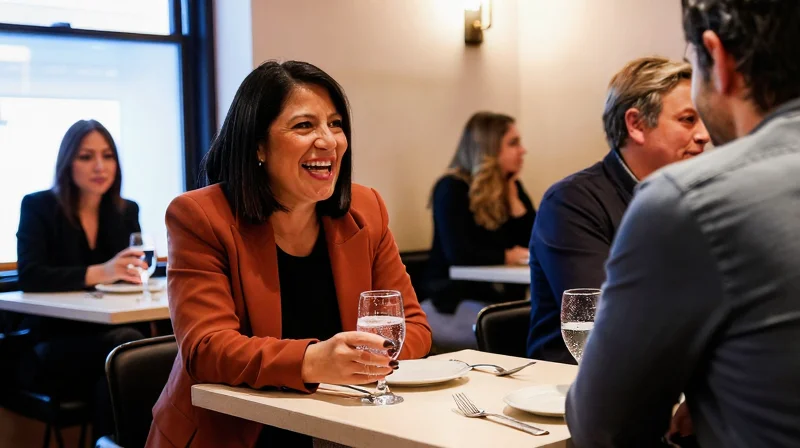
The standard dating tips for women — art galleries, restaurant openings, volunteer work — are written for someone who doesn’t exist. They assume abundant free time, physical energy, and a social life that already provides regular context for meeting strangers. They also assume you want to be the one doing the approaching, unprompted, in an unstructured setting.
Organized singles events solve most of these problems at once.
Meetup.com-style singles mingle groups and structured singles events (speed dating, activity-based meetups) work better for the specific constraints of midlife for a few reasons:
- Single session, repeatable — you go once, see if it’s worth your time, and decide from there. You’re not committing to a lifestyle.
- Air conditioning — this sounds like a joke; it is not a joke.
- Structured context — you don’t have to manufacture a reason to talk to someone. The format does that.
- Side benefit: friendship — this one is the most underreported outcome in this space.
On that last point: going alone to a singles mingle group, meeting a group of strangers around 50 at a restaurant, and coming away with both a match and a new social circle — this happens more than the advice literature acknowledges. That outcome — meeting other single women your age as a meaningful side effect — matters, especially when your existing social infrastructure has thinned out alongside your coupled-up friends.
Speed dating events in most mid-size and large cities run on weeknights. They’re usually low-key, over in two hours, and have a built-in filter: everyone there wants to meet someone. That specificity changes the social dynamic completely compared to hoping an acquaintance introduces you to someone at a dinner party.
If You Do Want to Date Younger Men: What’s Real vs. What’s Marketing
If this is what you’re looking for, the coverage exists — but most of it is marketing dressed as advice.
Cougar Life and CougarD frame the dynamic as inherently empowering (“compatibility has no age limit,” “where mature confidence meets younger energy”). The “cougar” label itself is worth examining before you select a platform built around it. In the communities where this topic comes up, the label lands as a punchline far more often than an identity — the Steve Irwin narration writes itself: Crickey, there she is, the cougar in her natural environment, prowling the aisles at TJMaxx.
That’s not gentle ambivalence. It’s open mockery of the framing, and it tells you something about how the outside world reads it regardless of how women in these relationships actually experience them. The label says more about external perception than internal reality.
The real dynamics worth thinking through:
- Different life stage goals: A 48-year-old and a 31-year-old may want incompatible things in 5 years — and this is worth thinking about explicitly, not dismissing.
- Social context: Family judgment and peer perception don’t disappear because you’ve decided not to care about them.
- Communication differences: Not about intelligence — about reference points, cultural context, and what “serious” means to each person.
For platforms: Cougar Life has the largest self-identified user base for age-gap relationships. Zoosk has substantive population and is less niche-coded. CougarD has claimed large numbers; its user base quality is harder to verify, and its branding carries the scam-risk concerns covered above. Our guide to older woman/younger man relationships covers the real-world dynamics in more depth.
Re-Entering Dating After Divorce or Widowhood: The Part Nobody Covers
Coming back to dating after a long relationship means encountering norms, platforms, and vocabulary that didn’t exist the last time you were in the market. That’s genuinely disorienting and almost never acknowledged in dating advice.
Here’s what’s actually different: the entire infrastructure has changed. Apps are now the default meeting mechanism, not the backup for people who couldn’t connect “naturally.” Profiles require photos you chose and uploaded yourself, which is its own adjustment. Early communication now runs as continuous text threads with an informal expectation of response within hours — nothing like the phone calls you scheduled in advance.
The social norms around who initiates, how quickly things move, and what terms like “talking to someone” or “situationship” signal are a new vocabulary. None of this is insurmountable. It’s just genuinely new, and naming that the learning curve is real is more honest than pretending it isn’t there.
Three of the most common search questions from this audience are about terminology that circulates on apps and in profiles:
- GGG — coined by advice columnist Dan Savage. Stands for “good, giving, and game” — meaning a sexual attitude that’s generous, willing, and open to a partner’s interests. You’ll see it in profiles on Hinge and OkCupid. It’s a values signal, not an acronym for anything alarming.
- 6-6-6 rule — an informal social media meme (six feet tall, six figures, six-pack) describing an imaginary standard for male attractiveness. It circulates on social media and TikTok. It’s not a real framework anyone applies; it’s good to know it exists so it doesn’t seem like insider knowledge.
- 3-3-3 rule — a structured pacing framework designed specifically for re-entry daters: roughly three dates in the first three weeks, don’t commit to exclusivity until the three-month mark. It exists to check the pattern of moving too fast — which happens when someone is ready for partnership after a long gap and mistakes early intensity for compatibility. If you find yourself wanting to be official after two weeks with someone, the 3-3-3 framework is the deliberate pause that prevents a decision you’ll regret at month four.
The loneliness of re-entry is real. Dating while grieving a marriage or a partner is its own thing. If you’re carrying that, therapy with someone who specializes in life transitions is a legitimate resource — not a consolation prize for people who can’t figure out dating. Our re-entering dating guide goes deeper on this specific situation.
Frequently asked questions
What does GGG mean on a dating site?
GGG — “good, giving, and game” — is a term coined by advice columnist Dan Savage to describe a positive sexual attitude: willing to be generous with a partner, open to their interests, and enthusiastic rather than performative. You’ll encounter it in profiles on Hinge, OkCupid, and similar apps as a shorthand for sexual compatibility values.
What is the 6-6-6 rule in dating?
The 6-6-6 rule is an internet meme — mostly circulating on social media — that describes an imagined minimum standard for male attractiveness (six feet tall, six-figure income, six-pack abs). It’s not an actual framework anyone applies in real dating; knowing it exists means you won’t encounter it and feel like you’ve missed something.
What is the 3-3-3 rule in dating?
The 3-3-3 rule is a pacing structure for early dating: three dates within the first three weeks, then a three-month period before committing to exclusivity. It’s used particularly by people re-entering dating after a long relationship to avoid moving too fast — a pattern that tends to happen when someone is ready for partnership after a long gap and mistakes early intensity for compatibility.
What is the best dating app for a woman over 45?
Match.com and eHarmony are the most consistent recommendations for mature women dating within their own age group or a similar life stage. Match has the broader user base; eHarmony pre-selects for people seeking serious relationships. For age-gap relationships specifically, Zoosk is a safer option than niche cougar-branded apps, which carry elevated romance scam risk.