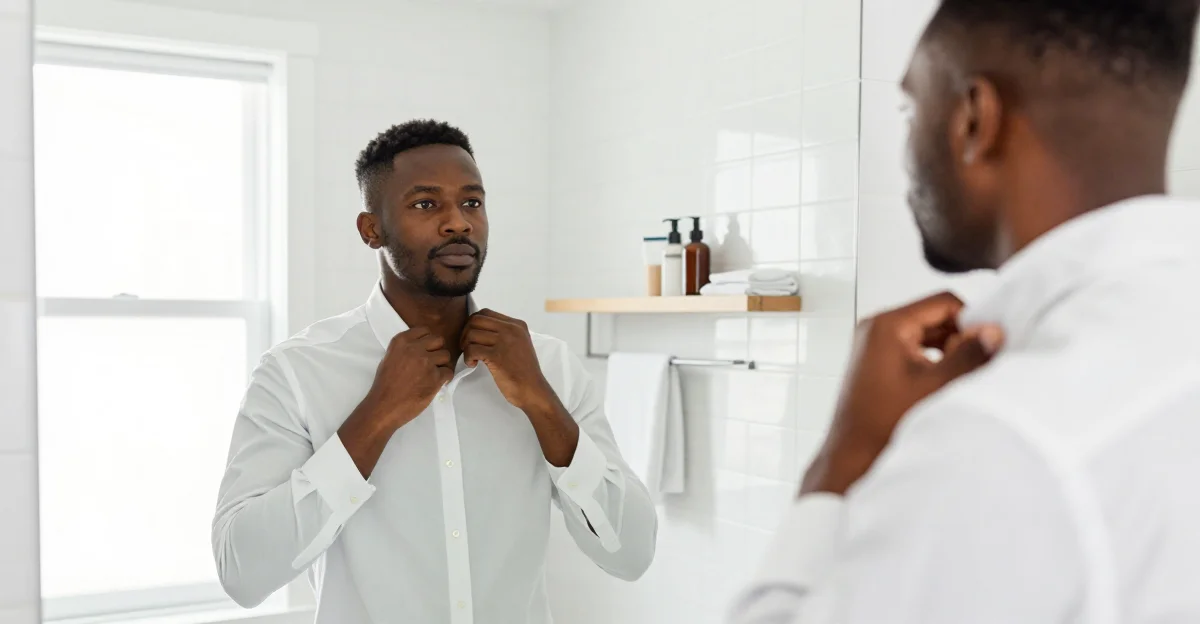
Most men’s dating guides fail because they hand you tactics before you’ve identified what’s actually broken. This men’s dating guide works differently — it starts with an honest self-inventory, because without that, no advice is useful.
If you’ve read the advice, tried the approaches, and still feel stuck, this is written for you. Not for someone starting from scratch. For someone who’s already put in effort and doesn’t understand why it isn’t translating.
TL;DR
- Most men don’t need more tactics — they need to identify their specific bottleneck first.
- Physical investment (fitness, grooming, photos) outweighs any opener or text strategy.
- Volume only helps after your baseline is worth repeating.
Why the Standard Advice Doesn’t Work on Men Who’ve Already Tried
“I’ve read all the advice and I’m still invisible.” That’s not a confidence problem. That’s a diagnostic problem.
Most dating content is written for someone who hasn’t started yet — someone who needs permission to try, encouragement to put themselves out there, assurance that it’s possible. But that’s not who searches for a men’s dating guide after their third year of trying. You don’t need to be told that connection is possible. You need to know why your specific efforts aren’t producing results.
Generic advice fails experienced men because it assumes a blank slate. “Be confident” has no implementation path. “Be yourself” tells you nothing about which self to show, when, or how. The men who find this advice useless aren’t being lazy — they’ve already internalized the motivational framing and moved on. What they’re missing is the layer underneath: actually listen instead of waiting for your turn to impress her, stop performing and start tracking what’s creating friction.
The frustration isn’t about lacking effort. It’s about effort without feedback. If you’ve spent a year optimizing your opener and your matches still fade after two exchanges, your opener wasn’t the problem.
Run a Diagnostic Before You Touch Any Tactic
Before you add any new approach, do this: identify which of four variables is your actual bottleneck.
- Baseline attractiveness — How you look in photos, in person, and how you present physically. This is the starting point, not the finish line.
- Volume — Are you generating enough interactions to get real feedback, or are you running 10 swipes a week and calling it a sample size?
- Approach calibration — How you’re moving through interactions. Where do conversations die? After the match? After the first exchange? At the transition to meeting?
- Environment — Are you in a city, age bracket, or demographic where your target pool is large enough for your methods to work?
Most men failing at dating are doing so in the middle — not at the start. They’re stuck at the texting phase, losing momentum after the first few exchanges, or struggling with the move from casual conversation to something intentional. That’s approach calibration. Fixing your bio doesn’t solve it.
This is where most dating advice for men goes wrong — it assumes every man has the same failure point. Yours is specific. Find it before you try to fix it. How to be more confident is an output of fixing the right thing — it’s not a prerequisite you manufacture in advance. “Be someone worth dating first, then let that show” is a more honest framing than “project confidence before you feel it.”
Write down where interactions end. Not “they don’t work out” — where, specifically. That location in the sequence tells you what to work on.
The Baseline Work That Outweighs Every Opener
Your photos are doing more damage than your bio ever could. Not slightly more — significantly more. This is the most consistently confirmed pattern in every honest discussion about male dating outcomes, and it’s the piece most guides treat as a footnote.
Here’s what baseline investment actually means in practice:
- Fitness — Not to become someone different, but because it changes how you carry yourself, how you photograph, and how you take up space in a room. Six months of consistent training produces visible results that no opener replicates.
- Grooming — A haircut that fits your face, skin that’s maintained, clothes that fit. These are solvable problems. A tailor or a stylist consultation costs less than six months of dating app subscriptions.
- Photos — Natural light, candid shots, at least one that shows your full face and one that shows your height or body. No gym selfies as your primary. No bathroom mirrors. No group shots where you’re the worst-dressed person.
The emotional reality is that this work takes months, not a weekend. That’s frustrating if you want results now. But it’s worth being direct about: no amount of improved messaging compensates for photos that don’t represent you well. Fix the baseline first. Then optimize everything else.
Men who’ve improved their physical presentation and updated their photos consistently report that match rates and response rates change — not marginally. The variable that feels least like “dating advice” is doing most of the work.
Online vs. In-Person: Two Different Skills, Not One
Online dating and in-person approaches reward different things so completely that training only one creates an uneven skill set that’s hard to diagnose.
Online requires optimized photos and the ability to create interest in short text. You have roughly one image and two sentences to produce a reason to respond. The feedback loops are slow — you send messages, you wait, you adjust based on very little information. Pew Research data shows significant variation in online dating outcomes by age, gender, and geography — meaning the same approach that works in one city at one age doesn’t transfer directly elsewhere.
In-person rewards social presence, timing, and directness. You can recover a weak opener with genuine follow-through. You can’t. You can read real-time feedback and adjust. The calibration is faster because the signal is immediate. For a detailed breakdown of which apps are worth your time by demographic, our guide on the best dating apps for men covers the current scene honestly. If you’ve been primarily app-focused and the returns are diminishing, how to meet people without apps is worth reading before you assume dating itself is the problem.
The question isn’t which venue is better in the abstract. It’s which venue is right for your city, your age group, and what you’re looking for. Men in dense urban areas in their 20s have a different calculus than men in smaller cities in their late 30s. Don’t follow a strategy that was designed for a different person’s context.
How to Actually Move Past “Stuck” — Recalibration, Not Repetition
A dry spell doesn’t just affect dating outcomes — it affects how you show up in interactions. Scarcity becomes legible. Not because women can smell desperation (that’s a cliché), but because people who are over-invested in any individual interaction behave differently than people who aren’t. It’s visible in pacing, in how quickly you try to close, in how much you’re performing versus actually engaging.
The operational version of “develop confidence” is this: stop giving a shit about the outcome of any individual interaction. Not as a mindset exercise — as a practical result of having enough going on socially that no single conversation is load-bearing. That requires male friendships, activities, and a social life that exists independently of dating. Go to things you’d go to even if you met no one. Not as a dating strategy, but because it’s how humans function well.
Research on rejection sensitivity shows it has measurable behavioral effects — rejection genuinely affects motivation and approach behavior, not just mood. Rejection still stings every time; the goal isn’t to feel nothing but to not let it stop you. That’s a skill that gets built through processing, not bypassed through reframing.
After a breakup or extended dry spell, the reset process takes time. Trying to date at full intensity while still recalibrating usually produces worse results than waiting until you’re actually interested again, not just trying to fill a gap. If you’re re-entering after a significant relationship, our guide on re-entering dating covers the adjustment period more specifically.
The goal isn’t emotional neutrality. It’s non-paralysis. You can feel something and still take the next step.
Frequently Asked Questions
How do I get better at dating as a man?
Start with a diagnostic — identify whether your bottleneck is baseline presentation, volume, approach calibration, or environment before you add any new tactic. Men who apply the wrong fix to the right problem spend months getting nowhere. Locate the friction point first, then work specifically on that.
Is online dating or meeting people in person better for men?
They require different skills and produce different psychological effects — the right answer depends on your city, your age group, and what kind of relationship you’re pursuing. Online dating disadvantages men statistically, but remains the highest-volume option in most demographics. In-person rewards social presence in ways apps can’t replicate, and for many men outside major urban centers, it’s the more viable primary channel.
How do I handle rejection without it stopping me?
Rejection is genuinely painful every time; the goal isn’t to feel nothing but to not let it prevent the next attempt. Emotional processing is a skill, not a mindset switch — it gets built through repetition and through having enough social context that one rejection isn’t catastrophic. The “numbers game” framing isn’t wrong, but it’s incomplete: dismissing the emotional cost without guidance on how to process it isn’t useful.
What actually makes a man more attractive to women?
Physical investment — fitness, grooming, and photos — has the most documented impact on dating outcomes, followed by social presence and directness in person. Openers and texting strategy matter far less than most men assume. Fixing a weak photo set produces larger measurable changes than any conversation technique.
When should I get a dating coach?
When you’ve honestly assessed your bottleneck, applied targeted changes for at least a few months, and still can’t identify what’s creating friction — a coach provides diagnostic help, not motivational support. If you haven’t done the self-inventory first, coaching is expensive guesswork. The right criteria for hiring one is a specific, persistent problem you can’t solve with information alone.